AI Background Removal vs. Manual Clipping Path
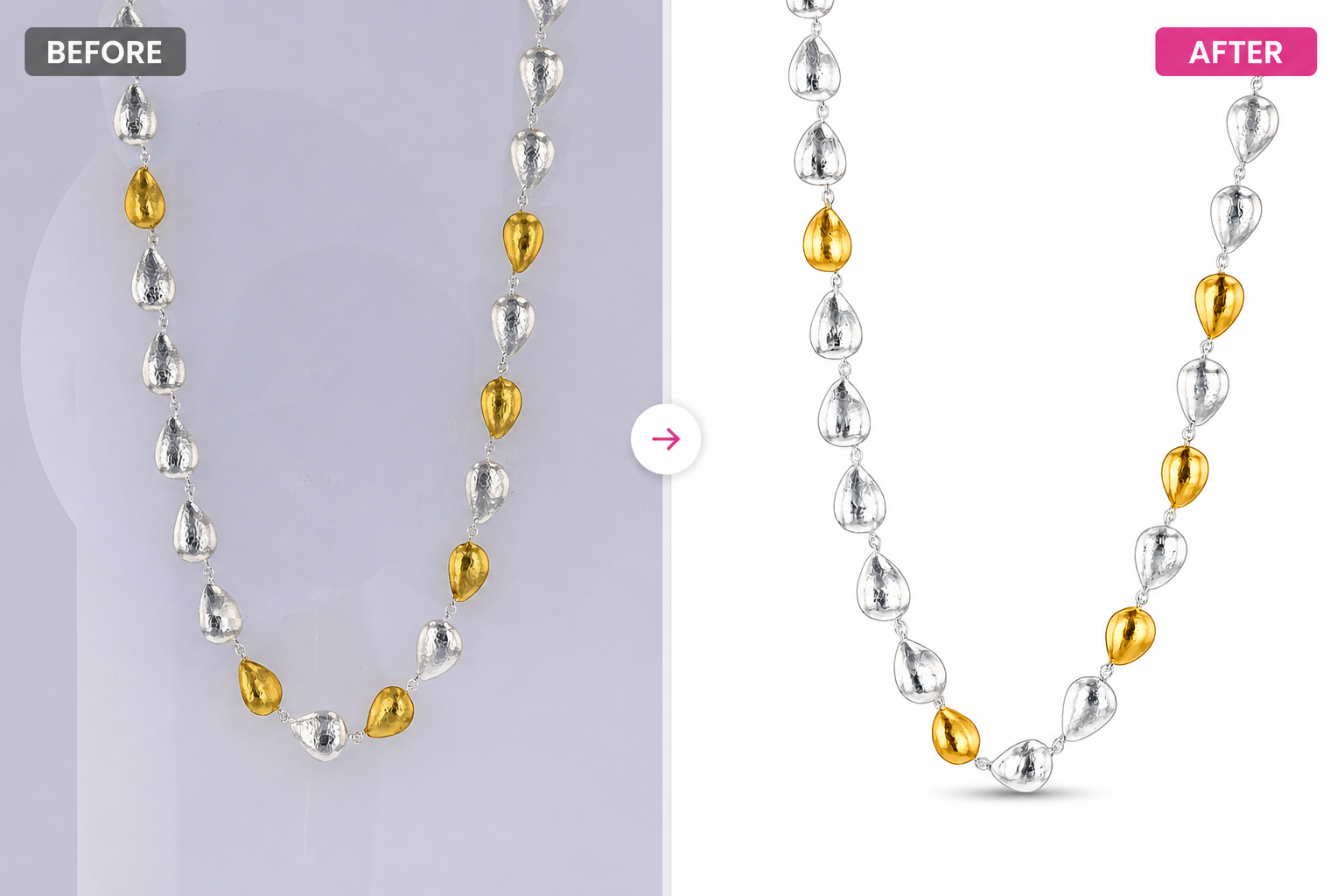
The difference between a product sale and a missed opportunity can often come down to one single factor: product images. If you are selling on Amazon, Shopify, eBay, or through your own web store, customers always expect bright, clean, and well-executed product photos which they can trust at a glance. The major element in making product images high-converting is background removal i.e. replacing distracting or untidy backgrounds with a neat, pure white one. But should you go for AI background removal or get a manual clipping path service? Let’s have a discussion about AI Background Removal vs. Manual Clipping Path.
E-commerce businesses, ad agencies, photographers, and other entities face with this issue regularly. AI tools based on machine learning depict speed and automation to an extent of processing a large number of images within minutes. Still, manual clipping path services are performed by highly trained photo editors who produce very refined and accurate cuts as well as high-quality results which AI quite often fails to do.
Picking the right option might affect your image quality, editing process, presentation of your brand, and even your sales figures. In this piece, we will take a thorough look at AI background removal in comparison with manual clipping path services, considering aspects such as speed precision pricing, scalability, and actual examples, to help you make your choice with a clear head.
What is AI background removal?
AI background removal uses artificial intelligence to automatically detect and separate subjects from image backgrounds. Powered by deep learning and edge detection technology, these tools offer fast and cheap editing, ideal for art directors and businesses handling large image volumes.
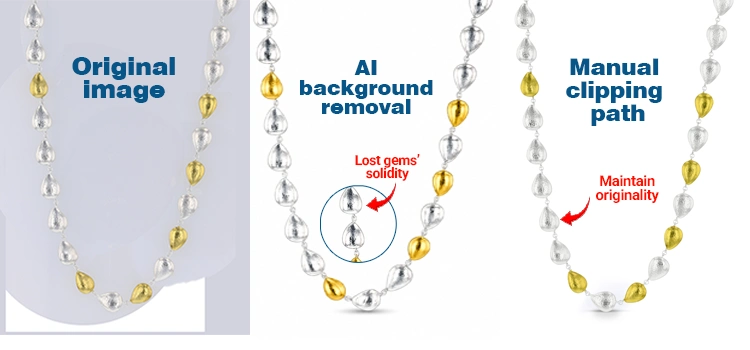
Scrutinise the above image, AI fails to maintain the details. It reduces the solidity of the product gems and somewhat added stroke around the gems. AI transforms the gems into as if light-bulb, huh! Such product image quality, especially of specious jewellery product, is not appropriate at all.
AI background removal refers to the technology that applies artificial intelligence to a photo to identify the main subject and extract it from the background without any manual work. You simply put up a picture, the program runs the code, and just a few seconds later, you have a cutout with a clear or white background.
Currently, most AI-based applications operate through:
- Deep learning architectures that have been exposed to millions of images.
- Edge detection modules that try to determine where the subject ends.
- One click or “remove background” options in web apps or plugins.
These automation tools prioritize speed, scalability, and user experiences. They are aimed at marketers, social media content makers, and small ecommerce operators who want “good looking” results quickly without much effort at lower prices.
What is Manual clipping path?
Manual clipping path is a human-led photo editing technique using tools like Photoshop’s Pen Tool to create precise outlines around subjects. It ensures high-quality results with accurate edge detailing, making it ideal for professional product photo editing and premium visual presentation.

Manual clipping path is a person controlled method where a photo retoucher takes advantage of vector oriented tools (such as the Pen Tool in Photoshop) to create an extremely accurate contour of the subject. This outline may then be used as a mask or selection, and the background can be discarded or replaced.
Essential elements of manual clipping path are:
- Hand drawing is employed for every bend, corner, and edge.
- Retouchers enlarge the image and meticulously follow the contours of hair gems lace, and other delicate elements.
- The final output is a vector style, crisp, and changeable outline that looks clean even when enlarged for print.
This method is part of professional photo‑editing workflows at full‑service studios and dedicated clipping‑path service providers.
What are the differences between AI background removal and Manual clipping path?
AI background removal delivers fast, automated editing for bulk images, while manual clipping paths provide precise, high-quality results. Businesses often combine both methods to balance speed, consistency, cost, and professional image quality for better brand presentation and sales.
The goal of both AI background removal and manual clipping path is to isolate a subject from its background, though they operate the process differently and the results differ greatly. AI background removal relies on artificial intelligence and deep-learning networks to identify the primary object in a photo and separate it from the background with minimal without human assistance. This approach is quick mainly for straightforward product photography or social-media pictures where absolute edge precision is not the priority. However, a manual clipping path is a meticulously drawn vector contour made by a skilled photo editor, typically using tools like Pen Tool in Photoshop that very accurately and controllably separate the subject- product image.
Speed and Volume
These issues are some of the most notable differences. For instance, an AI tool for background removal can handle hundreds or even thousands of images within a matter of minutes. So, making it perfect for e-commerce catalogs of large scale or quick design drafts when time is the essence for business turnaround. It handles well the basic shapes, the clear contrast, and the standard product photos. That being said, such speed comes with a trade-off: AI techniques have difficulties with complex details of product photos, low-contrast edges of hair or fur, glass, and transparent objects, which can result in blurred or jagged edges requiring manual finish.
Slow but High-end Quality
Manual clipping paths conversely are slower since every curve, corner, and edge is precisely drawn by human hands, sometimes even taking up to over an hour for the more complicated cases. Then again, such slowness allows for one major benefit: highly defined, clear, and perfectly scalable edges. Since the outline is vector-based, it remains sharp even if the image is magnified for printed materials, billboards, or high-resolution catalogs. Manual paths are most of all important when it comes to fashion, jewelry, beauty, and luxury products where even the smallest needs to be perfect to maintain brand trust and visual quality.
Consistency and Reliability
Another major difference is consistency and reliability. AI tools are often inconsistent; for example, one picture can be perfect while the next one will be a complete mess. That’s because the computer tries to guess the edges using pixels and patterns. Such unpredictability may cause brand loss of a professional character which require every product image to be uniform and polished.
However, manual clipping paths are consistent almost by default. A professional photo retoucher can easily duplicate edge style, corner sharpness, and same results in thousands of images. That is why many top brands and professional agencies still use manual or hybrid workflows in producing high-impact product listing.
Cost and Workflow
They are other factors that differentiate these two methods. Usually, AI background removal is the cheaper alternative, mainly if you use subscription-based tools or free services, since you don’t have to pay for human work. Still, if corrections have to be made and files to be reprocessed, it could result in hidden costs.
Manual clipping paths typically have a higher price per image as they require skilled image editors and more sophisticated software, but they are often able to generate higher returns with better-looking images, fewer marketplace rejections, and increased customers trust.
In essence, AI background removal is intended for speed, handling large volumes, and simple repetitive tasks where “good enough” quality is acceptable. Manual clipping paths are the way to go if you want accuracy, uniformity, and projects with high value where every detail must be flawless. Nowadays, a lot of businesses adopt a mixed strategy: they first use AI to quickly handle most of their images, and then do manual clipping paths only for those complex or high-impact images which contribute the most to their brand and sales.
What are the pricing differences of AI Background Removal, Manual clipping Paths, and Hybrid photo editing?
AI background removal is the cheapest and fastest option, manual clipping paths deliver the highest precision and quality, while hybrid editing balances cost and accuracy by combining AI automation with human touch-ups for professional e-commerce image results.
Since AI background removal, manual clipping paths, and hybrid photo editing require of human involvement, technology, and accuracy, they naturally have different prices. Typically, AI background removal is the least expensive option; manual clipping paths fall on the higher end of the spectrum; and hybrid methods occupy the middle ground, offering a good compromise between cost and quality.
Pricing of AI background removal
AI background removal is the most cost effective way for majority of companies to operate. For example, Removal.AI and Adobe Express both feature free background removal of simple images and only charge when you require higher resolution, faster processing, or bulk orders. There are mainly free AI tools available or almost free ones for low-volume that are small images or for personal projects.
Paid AI plans typically charge only a few cents or a fixed monthly fee based on the number of images for agencies or e-commerce brands that need a large volume. Some AI photo editing services that remove backgrounds in high volume charge about $0.20-$0.50 each, so the price per photo becomes very low when you process thousands of images. The main benefit is that you are paying almost nothing for the automated part of the workflow still you might still need the editor’s time to fix errors, which adds a hidden cost.
Manual clipping path pricing
Manual clipping path is generally more costly, as highly trained editors are required to trace each edge by hand with the help of the Pen Tool in Photoshop.
Price is mostly in a per-image form and is influenced by the complexity and volume.
Samples of public pricing from clipping path firms are below:
- Basic or simple clipping paths (objects with solid shapes like bottles boxes simple shoes): around $0.25-$0.59 per image.
- Medium complexity (objects with many curves, the presence of more than one shape or small objects in close proximity): usually $1.00-$1.99 per image.
- Complex or super-complex paths (jewelry lace mannequins, groups of products): frequently $3.00-$7.00+ per image, sometimes even higher for very detailed work.
In addition, a lot of services provide volume discounts, so if you are sending hundreds or thousands of images per month, your per-image price can be greatly reduced, sometimes even below $0.30 for standard edits. This is why manual clipping paths remain a feasible option for the expensive products of catalogs only because the base rate is higher than AI.
Pricing for hybrid photo editing
Hybrid photo editing is a blend of AI and manual labor: first AI machines carry out the tasks (for example background removal or basic masking), then humans only work on the parts that are difficult. This approach aims to keep the costs down compared to full manual editing while still providing you with very good quality.
Different examples of hybrid pricing
Hybrid editing combines AI speed with manual refinement, costing around $0.30–$0.80 per image for e-commerce. It delivers cleaner, more professional results than AI alone while remaining more affordable than full manual clipping path services.
Some AI-assisted editing services may charge about $0.22 per image for processing thousands of photos with AI and then a small manual-touch-up fee will be added on top.
Other top-end “hybrid edit” packages (most common in wedding and portrait photography) can ask for $75-$100+ per image, yet these are heavy retouching, color grading, and design work, not just background removal.
Content wise, hybrid pricing for background-centered work is very often in the range between pure AI and full manual clipping path. For e-commerce, under a hybrid model, you could be paying $0.30-$0.80 per image according to how much manual cleanup you will need. This is very appealing to brands that would like cleaner edges than what AI alone can offer, without having to pay full-manual rates for every image.
Quick pricing comparison table
Here is a simple snapshot of typical pricing ranges (in USD per image):
| Method | Typical per‑image range
(simple work) |
Typical range for complex work |
|
AI background removal |
$0.00-$0.50 (often cents) |
Same or slightly higher for heavy‑volume plans |
|
Manual clipping path |
$0.25-$0.60 |
$3.00-$7.00+ |
| Hybrid photo editing (AI + human) | $0.20-$0.80 for basic background‑focused edits |
Higher if bundled with deep retouching or design |
If your main concern is just quick and cheap background removal, then AI is generally the cheapest option. Still, if you want flawless, vector precise edges for print or high-end ecommerce purposes, then manual clipping paths would be more expensive but definitely worth it. Hybrid is sort of a compromise between the two, allowing you to reduce costs while still maintaining a good level of quality.
Conclusion
Both of these options have their advantages when it comes to e-commerce product image editing. An AI-based background removal can be very fast, highly automated, and cheap which can benefit many individual product images.
Still, manual clipping path services provide the best professional results for your images and offer the best treatment of complex product images. Ultimately, the decision is yours based on your business needs, how complex of an image editing you require, and quality expectations and of course, your budget.
If speed and batch processing is top priority, AI can help. Still if you require perfect high-end product image retouching that fulfill customer trust and accelerate your brand status, the manual editing processes are unbeatable. The great product from successful e-commerce brands today will be a blend of these two. Stand out AI with human inputs.