Why Outsourced Video Editing Fails for Many Creators?
Outsourced video editing sounds simple.
You make the content. Someone else edits it. You save time. Your videos look better. Your channel grows faster. That is the promise.
But for a lot of creators, the opposite happens. They hire an editor and suddenly everything feels harder. Turnaround gets messy. Revisions pile up. The content starts looking polished but weaker. The workflow feels slower, not faster.
Then they make the wrong conclusion. They think outsourced video editing does not work.
That is usually not true. Creators outsource too soon, with wrong expectations, or hire the wrong helper.
Outsourcing video editing works when you know what it does, what your editor needs, and your role in the process. Most creators skip that part.
They think they are buying time. What they are really buying is a workflow. And if that workflow is weak, outsourcing does not fix it. It exposes it.
Let’s talk about what creators get wrong about outsourced video editing and how to avoid making the same mistakes.
Suggested Article– Studio vs Outsourced Video Editing.
The biggest myth: editing is where content gets fixed
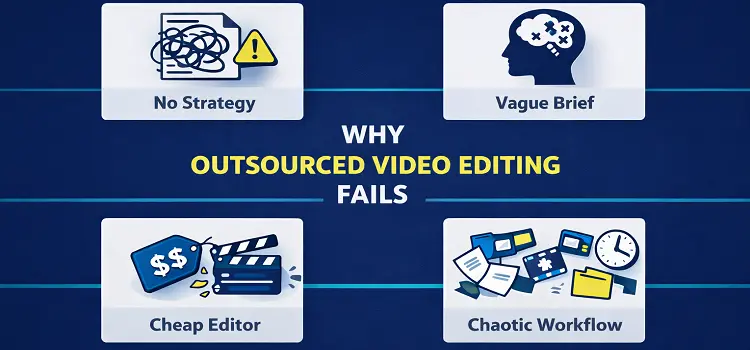
This is the first problem. Creators expect editors to turn weak content into something great. That is not how it works.
Editing can improve pacing. It can sharpen the story and cut dead space. Also, it can add captions, music, effects, zooms, graphics, and motion.
Furthermore, it can make good content better. But editing cannot rescue a bad strategy every week.
A weak hook shows immediately. Rambling forces the editor to cut around problems. An unclear message turns the edit into guesswork. And when the footage lacks energy, no amount of transitions can fix it.
This is why some outsourced edits look technically fine but still perform badly. The problem is not the editor. The problem started before the timeline opened.
Creators need to stop treating editing like repair work. Good editing is not a bandage. It is an amplifier.
Creators outsource too early
This happens all the time. A creator gets busy. They are tired of editing. They want more time to film, sell, or grow. So they hire an editor.
That sounds logical. But many do it before they have a stable format.
Nothing is stable: the intro changes, the tone shifts, the audience is unclear, the style is undefined, and the pacing is inconsistent. Sometimes they want something clean and simple. Other times they want loud, fast, and flashy. Their references are all over the place.
Then they hand the mess to an editor and expect consistency.
That is unfair. The editing support works best when your format is already working. Not perfect, just clear. Your format is clear, your structure is defined, and you understand exactly what your audience responds to.
That is when an editor can step in and help you scale.
If you are still reinventing your content every week, the problem is not editing capacity. The problem is lack of clarity.
Most creators give terrible briefs
This is probably the most common mistake in outsourced video editing.
Creators say things like:
“Make it engaging.”
“Make it clean and pop”
Or “Make it viral.”
These are not instructions. They are wishes.
A professional editor cannot work well with vague language. “Engaging” means different things to different people. One creator means tight pacing. For some, it means meme cuts and sound effects. For others, emotional storytelling or cinematic polish.
If your brief is vague, your result will be vague. Strong editors need direction. Not hand-holding. Direction.
They need to know the audience, platform, and goal. This includes what action the viewer should take and your style preferences.
The best outsourced relationships are built on strong briefs.
That does not mean you need a 10-page document for every video. It means you need a system that makes your standards clear.
A few examples, a style guide, a folder structure, clear naming, and repeatable feedback can do more than endless revision messages.
Cheap editing is often expensive
A lot of creators shop for outsourced video editing the wrong way.
They compare hourly rates or per-video prices and choose the cheapest option. Then they act surprised when the process becomes painful.
Cheap is not always bad. But cheap without process usually is.
The hidden cost of low-cost editing is not the invoice. It is the waste. Missed deadlines. Inconsistent quality. Endless revision rounds. Files sent in the wrong format. Slow communication. Poor understanding of pacing. Bad caption design. Sloppy storytelling.
All of that costs time. And time is the thing creators say they are trying to save.
The smartest way to judge outsourced video editing is not by asking, “How cheap can I get this?”
It is by asking, “How reliable is this workflow?”
A slightly higher-cost editor who understands your style, hits deadlines, and gets things close on the first pass is usually cheaper than a low-cost editor who needs constant correction.
This is not about being premium for the sake of it. It is about output quality and management cost.
Editors cannot read your mind
Creators often forget one thing: the editor is not inside the recording session.
They were not there when you set the tone, chose the key lines, or decided what to keep, cut, or emphasize. Without that context, they cannot know what matters.
Yet many creators act like the editor should just “get it.” Sometimes they will. Usually they will not, especially early on.
Outsourced video editing fails when editors lack context. Share your vision, audience, and goals to help them succeed.
Once that happens, the editor stops being a random pair of hands and starts becoming part of the creative system.
No system means no scale
This is where things really break.
A creator wants to post more often, so they outsource editing. But they still send footage through random links, change file names, forget brand assets, send feedback in five places, and ask for one-off exceptions every week.
That is not delegation. That is chaos with a helper.
Outsourced video editing only scales when the system is clean.
You need a consistent way to hand off raw footage. A clear folder structure. A place for music rules, fonts, logos, subtitles, lower thirds, thumbnails if needed, and export settings. You need turnaround expectations. Revision limits. Approval steps. Final file naming.
None of this is glamorous. But this is the stuff that separates creators who scale from creators who stay stuck.
The truth is simple. Editors do not create order. They plug into order.
If you do not have a repeatable system, every video becomes a custom project. And custom projects are slow.
Flashy is not the same as effective
A lot of creators judge editing quality by surface-level energy.
It becomes a race for more motion, effects, transitions, punch-ins, captions, sound design, and graphics. Sometimes that helps.
A lot of times it just hides weak content.
Good outsourced video editing is not about showing off what the editor can do. It is about supporting what the viewer needs. Clarity. Pace. Momentum. Emotion. Focus.
A flashy edit can still hurt performance if it distracts from the point. A simple edit can outperform it if it keeps attention on the message.
Creators need to stop asking only, “Does this look cool?”
They need to ask, “Does this help the viewer stay, understand, and act?”
That is the real test. Clarity beats effects in educational content. Rhythm beats polish in short-form. And in sales, trust and pacing win over entertainment.
The best editors understand this. The best creators do too.
One edit style does not fit every platform
This mistake is common and expensive.
A creator uses the same outsourced editing approach for YouTube, Instagram Reels, TikTok, LinkedIn, ads, and website videos.
That usually fails. Each platform has different viewer behavior. Each platform works differently when it comes to attention, expectations, pacing, and framing.
A YouTube video can build more slowly if the topic is strong. A short-form video usually cannot. A LinkedIn clip may need cleaner captions and a more professional feel. A direct-response ad needs to sell fast and clearly. A podcast clip may work with fewer effects if the insight is strong enough.
When creators ignore platform context, they blame the editor for poor results. But the issue is not editing talent. It is strategy mismatch.
Outsourced video editing works best when the editor knows exactly where the content will live and what that platform demands.
Feedback is where most workflows collapse
Here is another ugly truth.
Many creators are bad at feedback.
They say things like “not feeling it” or “this is off” or “can you make it better?”
That is not useful. It slows everything down.
Actionable feedback is specific. Tighten the first 20 seconds. Remove repeated phrases. Increase subtitle size. Cut faster between examples. Use fewer memes. Keep more natural pauses. Reduce music volume under voice. Match the pacing of reference video two.
That kind of feedback teaches the editor what good looks like.
Emotional feedback without specifics creates guesswork. Guesswork creates revisions. Revisions create frustration. Frustration kills the relationship.
If you want long-term success with outsourced video editing, treat feedback like training data. The clearer it is, the better future edits become.
Outsourcing does not automatically save time
This is the biggest misconception of all.
Creators think hiring an editor means the editing burden disappears. It does not. It changes shape.
You spend time briefing, reviewing, and giving feedback instead of just editing. This management work increases at first, but decreases as the editor learns your style.
That is normal.
The problem is that many creators are not prepared for that ramp-up period. They expect instant relief. When they do not get it, they quit too early or bounce between editors.
Outsourced video editing is not instant freedom. It is an investment in a repeatable content machine.
Machines take setup.
What good outsourced video editing actually looks like
It looks boring in the best way.
The creator knows their format. The editor knows the style. Files go into the right folders. References are easy to find. Turnaround is predictable. Feedback is clear. Revision rounds are limited. The platform goal is obvious. The final export is ready without drama.
That is what good looks like. It’s not about chaos, miracle edits, or freelancers guessing your brand every week. It’s about a system that works.
Good outsourcing feels smoother over time. The editor starts anticipating choices. The creator spends less time correcting. The videos start feeling more consistent. Publishing gets easier.
That is when outsourced video editing becomes an actual growth lever.
Before you outsource, fix these five things
Before hiring an editor, get your basics right.
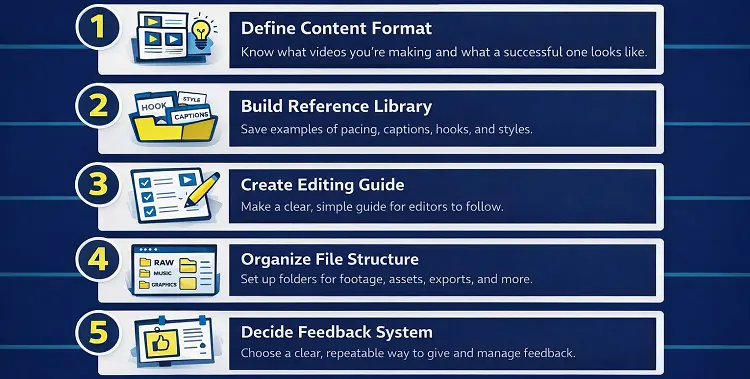
First, define your content format. Know what kind of videos you make and what a successful one looks like.
Second, build a small reference library. Save examples of pacing, captions, transitions, hooks, and graphic styles you like.
Third, create a simple editing guide. It does not need to be fancy. Just clear.
Set up your file structure with folders for raw footage, assets, exports, music, logos, fonts, captions, and final versions.
Fifth, decide how feedback will work. One place. One decision maker. One version of the truth.
Do these things and your odds of success go up fast. Skip them and even a talented editor will struggle.
The real role of the creator never goes away
This is the part many people do not want to hear. Even with outsourced video editing, the creator still owns the content engine.
You still own the idea. The audience insight. The hook. The message. The recording quality. The call to action. The overall content direction.
The editor supports that engine. They strengthen it, speed it up, and help package it better.
But they are not a replacement for strategic clarity.
That is why some creators win big with outsourcing while others keep cycling through editors and complaining.
The difference is not luck. It is leadership.
FAQs
Is outsourced video editing worth it for small creators?
Outsourced editing works best when the creator has a clear format and plan. It may cause problems if you’re still experimenting.
When should a creator outsource video editing?
Usually when editing is slowing down content production, your format is stable, and you can clearly explain your style, audience, and goals.
Why does outsourced video editing sometimes make content worse?
Because the creator often outsources before building a good system. Weak briefs, unclear style, poor feedback, and no platform strategy can lead to worse results even with a skilled editor.
How do I brief a video editor properly?
Tell them the platform, audience, and video goal. Share examples of styles you like and what to avoid, plus any brand rules.
Should I hire a freelance editor or an editing agency?
Hire a freelancer for close collaboration or an agency for scale and faster turnaround.
What is the biggest mistake creators make with outsourced video editing?
Editors can improve presentation, but they cannot fix weak ideas or poor messaging.
How much feedback should I give an outsourced editor?
Early feedback trains the editor on your standards, then less correction is needed over time to achieve alignment.
What matters more: a low price or a smooth workflow?
A smooth workflow. Cheap editing that creates delays, revisions, and confusion usually costs more in the long run.
Final Thoughts
Outsourced video editing is not overrated. But it is misunderstood.
Creators often expect it to solve the wrong problems. They think it will fix weak content, unclear direction, missing systems, and bad feedback habits. It will not.
What it can do is powerful. It can save real time. Improve consistency. Increase output. Raise production quality. Help you focus on ideas and growth.
But only if you’re ready. If your content system is messy, outsourcing will highlight the chaos.
If your workflow is clear, outsourcing can be one of your best choices. That is the truth most creators miss. The editor is not the shortcut. The system is.