Studio vs Outsourced Editing: What Scales Better?
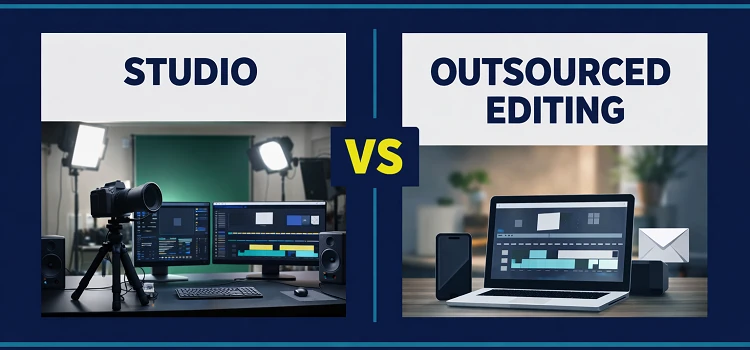
Most creative businesses do not hit a wall because they lack talent. They hit a wall because their editing workflow stops scaling.
At first, everything feels under control. A manageable number of files comes in. The team edits them. Revisions stay reasonable. Delivery stays on time.
Then growth starts. More products, more shoots, and more clients. Also, more SKUs, more revisions, and more pressure.
That is when the real question shows up. It is not, “Do we have good editors?”
It is, “Can this editing model grow without killing speed, consistency, and margins?”
That is why the studio vs outsourced editing debate matters. One model gives you tighter day-to-day control. The other usually gives you more capacity and flexibility. Both can work. But both do not scale the same way.
And that is the part many businesses ignore until the pressure becomes obvious.
This article explains the key differences between studio editing and outsourced editing. It covers where each method excels, where they face challenges, and which one scales better as volume increases.
What Studio Editing Really Means
Studio editing usually means the work is handled internally.
That could be:
- an in-house post-production team
- editors working directly inside your studio
- a dedicated internal department handling retouching, clipping, color correction, or other image editing work
On the surface, this model looks strong. You get visibility. You get direct communication.
Lastly, you get a team that learns your brand style over time. That is real value.
Studio editing often works best when:
- the workflow is highly customized
- the volume is stable and predictable
- the brand has strict visual rules
- the business wants tight internal control
But studio editing is not just a creative choice. It is an operating model. That means it comes with real structural weight:
- hiring
- onboarding
- training
- salaries
- equipment
- software
- supervision
- QA management
At low volume, those costs and limits may feel manageable. At higher volume, they start to matter a lot.
What Outsourced Editing Really Means
Outsourced editing means the work is handled by an external partner instead of a fully internal team.
That partner might be:
- a freelancer
- a specialized editing agency
- a dedicated production partner
- a larger outsourced team that works under your guidelines
A lot of business owners still hear “outsourcing” and think of one thing: cheap labor.
That is the wrong way to look at it.
Good outsourcing is not just about saving money. It is about creating production capacity without building a bigger internal structure. That is a huge difference.
A good outsourced setup usually runs on:
- SOPs
- style guides
- reference files
- QC systems
- feedback loops
- batch handling processes
- account management
So the real comparison is not “internal equals quality, outsourcing equals risk.”
The real comparison is this: which system can handle growth better without creating operational stress?
What “Scales Better” Actually Means
A lot of people use the word “scale” too loosely.
Handling more files does not automatically mean a workflow scales well.
A model scales well when it can grow without creating chaos.
That means looking at things like:
- volume capacity
- turnaround time
- cost control
- consistency
- training burden
- seasonal flexibility
- management complexity
- profit protection
So when we ask which model scales better, we are really asking:
- Can it handle rising volume without constant disruption?
- Can it keep quality stable as demand grows?
- Can it survive rush periods and seasonal spikes?
- Can it protect margins instead of adding overhead?
- Can it grow without becoming harder to manage every month?
That is the real test.
And once you use that test, the answer becomes much clearer.
Where Studio Editing Wins
Studio editing has real advantages. It would be lazy to ignore them.
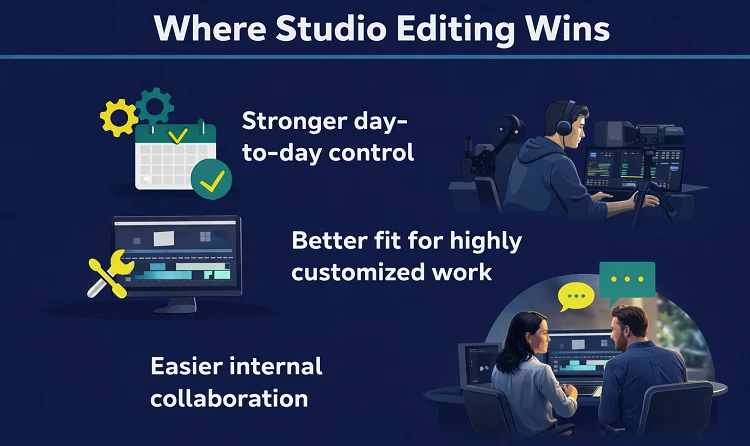
1. Stronger day-to-day control
When your editors are inside the business, communication is faster. Feedback can happen in real time. Small style corrections are easier to explain. Teams often feel more aligned because everyone is closer to the same production environment.
2. Better fit for highly customized work
Some workflows are too specific, too fluid, or too brand-sensitive to hand off easily. If every batch comes with unusual instructions or creative nuance, an internal team may respond faster.
3. Easier internal collaboration
Studio editing works well when editors need constant interaction with:
- photographers
- art directors
- designers
- production managers
- client service teams
That close collaboration can be valuable, especially on premium or complex projects.
4. More comfort for sensitive work
Some companies simply feel safer keeping everything internal, especially when handling confidential campaigns, unreleased products, or highly controlled brand assets.
These are real strengths. But none of them automatically means the model scales well.
Where Studio Editing Starts to Break
This is where many businesses get stuck. They confuse familiarity with scalability.
Studio editing can feel strong when the operation is small. Once volume grows, the weaknesses become harder to hide.
Hiring becomes the bottleneck
If your workload doubles, your internal capacity does not double on its own. You need more people.
That means:
- recruiting
- interviewing
- onboarding
- training
- supervision
- QA calibration
That process takes time. Meanwhile, the workload keeps moving.
Fixed costs keep climbing
Internal teams are expensive to expand. The business keeps paying for:
- salaries
- devices
- software
- office space
- admin overhead
- manager time
Those costs stay there even when volume slows down.
That is the problem with fixed-cost structures. They feel manageable during growth. They feel pain during quieter periods.
Capacity has a ceiling
Every internal team hits a limit.
Once that happens:
- turnaround slows down
- revision queues get longer
- rush orders create pressure
- overtime increases
- mistakes become more common
This is usually the moment when business owners realize the workflow is not actually built for scale.
Quality gets harder to maintain as teams grow
A small internal team can be very consistent. But as soon as you start scaling through new hires, maintaining quality gets harder.
Different editors interpret instructions differently. New team members often need time to match the existing standard. Managers spend more time correcting output instead of improving the business.
That is not efficient growth. That is drag.
Where Outsourced Editing Wins
This is where outsourced editing usually becomes much stronger. Its biggest advantage is simple: it adds capacity without forcing internal expansion.
That matters more than most businesses admit.
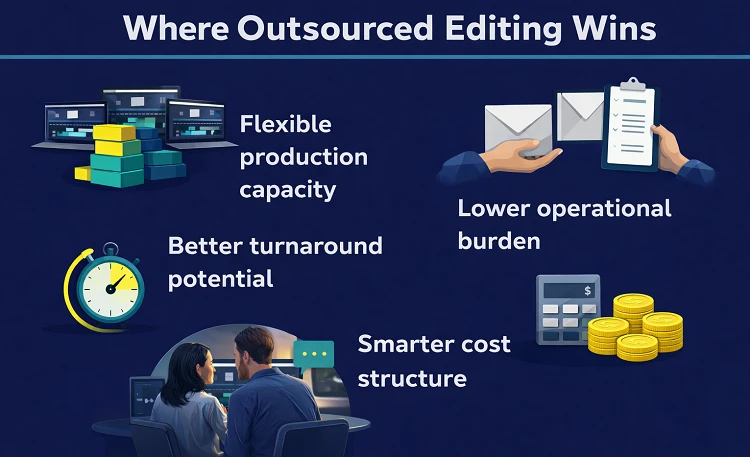
1. Flexible production capacity
A good outsourcing partner can absorb volume in a way internal teams often cannot.
That helps when:
- client demand rises quickly
- peak season hits
- a large batch lands suddenly
- a rush project needs faster turnaround
- your regular team is already near capacity
Instead of rushing to hire, you already have production support.
2. Lower operational burden
Outsourcing removes a lot of internal weight. You are not building a bigger in-house structure every time work increases.
That means less pressure around:
- staffing
- hardware setup
- training pipelines
- desk space
- production supervision
Your internal team can spend more time on growth, client experience, and quality oversight.
3. Better turnaround potential
Many outsourcing partners are built for volume. They often have:
- larger teams
- dedicated QC systems
- shift-based workflows
- round-the-clock capacity
- time zone advantages
That makes faster delivery more realistic, especially for bulk work.
4. Smarter cost structure
Outsourcing often turns a large part of editing cost from fixed into variable. That is one of the biggest reasons it scales better.
Instead of paying to maintain idle internal capacity, you pay for actual output.
That creates more flexibility in both busy and slow periods.
Where Outsourced Editing Can Go Wrong
Outsourced editing is not automatically better. Bad outsourcing is still bad operations.
If you choose the wrong partner, the system breaks fast.
Common outsourcing problems include:
- inconsistent quality
- weak communication
- missed deadlines
- repeated revision issues
- style mismatch
- poor accountability
That is why a lot of businesses say outsourcing failed them.
In many cases, outsourcing did not fail. Vendor selection failed. Process failed. Expectations failed.
Outsourced editing works best when the setup is structured. That means:
- clear briefs
- visual references
- defined quality standards
- revision rules
- organized communication
- strong account handling
Without those things, friction is almost guaranteed.
There is also partner dependency risk. If you rely too heavily on one weak vendor, your workflow becomes vulnerable.
So yes, outsourcing has risks. But the key point is this: smart outsourcing scales well, careless outsourcing does not.
Studio vs Outsourced Editing: Head-to-Head
If you strip away emotion, the comparison gets easier.
Studio editing usually wins on:
- direct control
- immediate communication
- tight internal collaboration
- niche or highly custom work
Outsourced editing usually wins on:
- volume flexibility
- lower operational burden
- faster scaling
- variable cost structure
- seasonal surge handling
- bulk turnaround support
That is why the answer often changes as a business grows. At a small scale, studio editing can feel better because control is more visible.
At a larger scale, outsourced editing often performs better because capacity becomes the real challenge.
And capacity problems are brutal. They affect delivery, quality, client satisfaction, margins, and team stress all at once.
The Real Winner for Many Businesses: Hybrid
This is where smart companies usually land. Not fully internal. Not fully external. Hybrid.
A hybrid model lets you split work based on what actually makes sense. For example:
- internal team handles art direction, QC, premium work, and brand-sensitive files
- outsourced team handles bulk editing, repetitive tasks, overflow, and high-volume production
That structure gives you two major advantages. First, you keep control where it matters most.
Second, you gain capacity where it matters most. A hybrid model can help you:
- avoid over-hiring
- reduce internal bottlenecks
- protect turnaround during peak periods
- maintain quality oversight
- grow without turning your internal team into a constant pressure point
This is often the most practical long-term setup because it is built around workflow logic, not ego.
Signs You Have Outgrown Studio-Only Editing
A lot of businesses stay internal too long because the system still feels familiar.
But familiar does not mean efficient. You may have outgrown studio-only editing if:
- turnaround times keep slipping
- the team is always overloaded
- peak seasons feel chaotic every time
- managers spend too much time fixing workflow issues
- rush orders create panic instead of confidence
- quality drops when volume rises
- hiring cannot keep pace with demand
- editing costs are rising faster than revenue
If you are seeing several of these problems at once, the issue is probably not effort.
It is structured. And no amount of extra effort can fix the wrong structure for long.
So what should you choose?
Choose studio editing if your workload is stable, your projects are highly custom, and you truly need constant hands-on control.
Choose outsourced editing if your volume changes often, your work is repeatable, your deadlines are tight, and you want growth without constant hiring.
And, choose a hybrid model if you want both control and scalability without the full weight of building everything internally.
That is the practical answer. Not the romantic answer. Not the defensive answer. The practical one.
Final Verdict
So, what scales better: studio editing or outsourced editing?
For most growing businesses, outsourced editing scales better.
Not because internal teams are weak. Not because control does not matter. But because growth puts pressure on capacity, turnaround, consistency, and cost. Outsourced editing is usually better built to absorb that pressure.
Studio editing can absolutely work. It can even be the right choice for smaller teams, custom workflows, or sensitive projects. But when volume rises, internal editing often becomes slower, heavier, and more expensive to expand.
That is the truth.
If your goal is long-term growth without constant hiring, operational stress, and delivery bottlenecks, outsourced editing is usually the more scalable model.
And for many businesses, the smartest answer is even better than that: keep strategy and quality control close, then use outsourcing for the production weight.
Because in the end, this is not really about where the editing happens.
It is about whether your workflow can grow without becoming the thing that holds your business back.