How Was eCommerce Sales, Product Photography, and Photo Editing in 2025?
2025 did not feel like a breakout year for ecommerce sales. It felt like a pressure year.
E-commerce sales were massive, but growth slowed. Competition intensified. Platforms tightened rules. Buyers became less forgiving. And in that environment, product photography and photo editing quietly became deciding factors, not creative extras.
If you zoom out, 2025 tells a clear story: ecommerce matured. And when markets mature, visual quality stops being optional.
This article breaks down what actually happened in ecommerce sales in 2025, how product photography performed in that reality, who relied on photo editing services, and how editing evolved in the AI era.
How was global ecommerce sales in 2025?
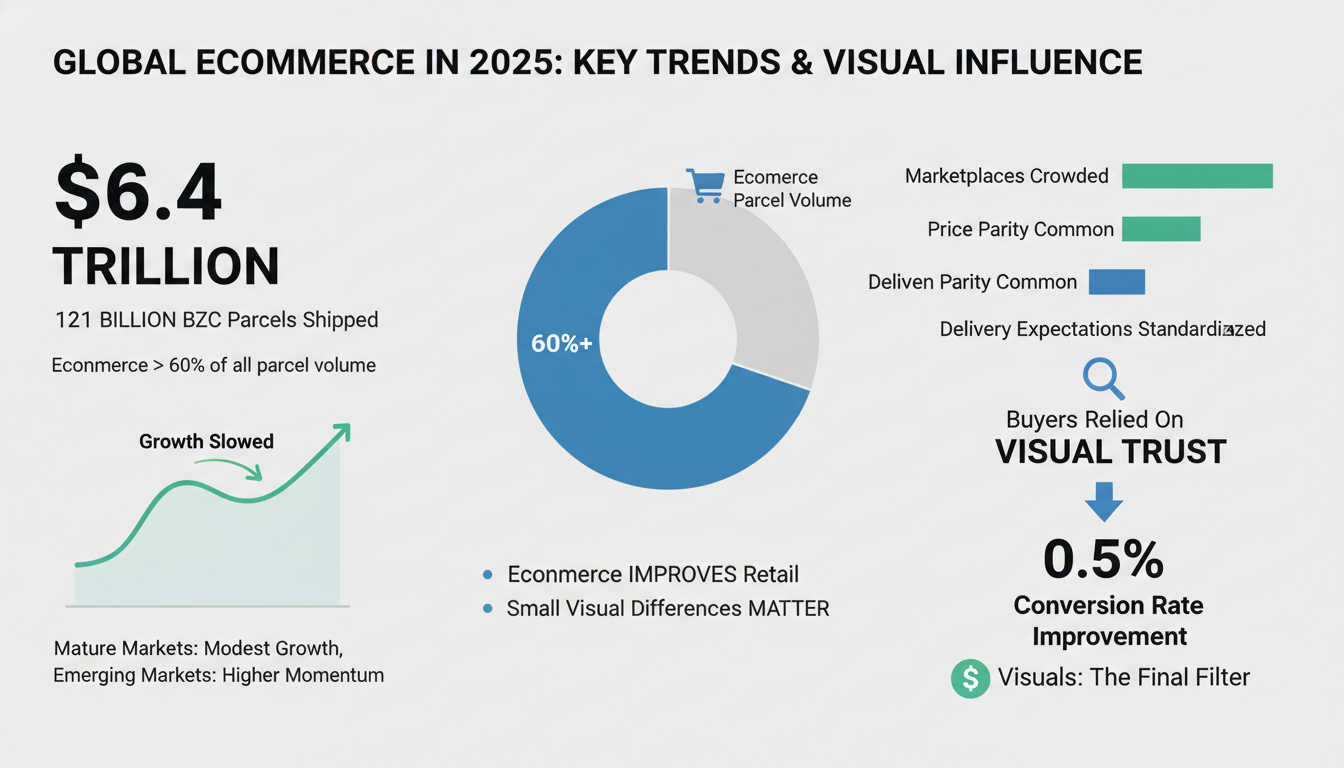
By most industry estimates, global ecommerce sales reached roughly $6.4 trillion in 2025. That sounds enormous, and it is. But the more important insight is how that money moved.
Growth slowed, volume concentrated
Compared to the explosive pandemic years, 2025 growth was slower and more uneven. Mature markets like the US and Western Europe saw modest increases. Emerging markets carried more momentum, but margins were thinner.
One of the clearest indicators of scale is logistics data. Analysts estimate around 121 billion B2C ecommerce parcels shipped globally in 2025, with ecommerce accounting for more than 60% of all parcel volume worldwide.
That means two things:
- Ecommerce is no longer “disrupting” retail. It improves retail.
- Small visual differences are now evaluated across billions of buying decisions.
When volumes are this high, conversion rate improvements of even 0.5% matter. And that is where visuals step in.
Buyers had more choices and less patience
In 2025:
- Marketplaces were crowded.
- Price parity was common.
- Delivery expectations were standardized.
So buyers relied on visual trust to break ties. When price, reviews, and delivery looked similar, images became the final filter.
How did product photography perform in 2025?

Product photography did not decline in importance. It became more functional and more judged.
Photography became the product experience
In physical retail, shoppers validate quality with their hands. Online, photography carries that responsibility. In 2025, buyers expected images to answer questions like:
- What does this feel like?
- How big is it, really?
- Is the color accurate?
- Will it look cheap in person?
Studies on ecommerce UX consistently show that product images are the first element users interact with on a product page. Not price. Not description. Images.
That behavior did not change in 2025. What changed was tolerance. Buyers were quicker to abandon pages where images felt unclear, inconsistent, or misleading.
Mobile viewing raised the bar
Most product discovery now happens on small screens. On mobile:
- Cropping mistakes are obvious
- Inconsistent whites look gray
- Bad edges scream “low quality”
- Overexposed highlights look fake
Photography that worked on desktop in 2019 often failed on mobile in 2025. This pushed brands toward:
- Cleaner compositions
- Fewer background distractions
- Stronger subject isolation
- More predictable framing
Lifestyle vs catalog photography split further
2025 clarified a pattern:
- Lifestyle images drive emotion and discovery
- Catalog-style images drive conversion
Successful brands stopped trying to force one image to do both. Instead, they built structured image sets:
- Hero image for trust
- Detail shots for inspection
- Lifestyle shots for context
- Scale references for realism
Photography was not just about beauty anymore. It was about clarity and sequence.
Why did photo editing matter so much in 2025?
If photography sets the foundation, photo editing made it usable at scale.
Marketplace rules tightened, not relaxed
Major platforms enforced stricter image requirements:
- White background purity
- Clean edges
- Correct aspect ratios
- No misleading enhancements
A well-shot photo could still be rejected or underperform without proper editing. Editing was not about “fixing bad photos.” It was about meeting platform expectations consistently.
Editing closed the trust gap
In 2025, buyers expected:
- Accurate color
- Realistic texture
- Clean presentation
- No visual surprises
Photo editing helped remove friction:
- Correcting lighting inconsistencies
- Normalizing shadows
- Cleaning reflections
- Making labels readable
- Ensuring product-to-product consistency
This was not cosmetic. It reduced hesitation.
Consistency became a brand signal
One of the biggest visual differences between high-performing stores and struggling ones in 2025 was catalog consistency.
Inconsistent editing sends subtle signals:
- Different whites feel unprofessional
- Shifting shadows feel unplanned
- Color variation feels risky
Consistent editing, on the other hand, builds subconscious trust. It tells buyers:
“This brand knows what it is doing.”
That consistency almost always required dedicated ecommerce photo editing services.
Who used photo editing services in 2025?
The buyer base expanded.
Marketplace sellers
Amazon, Walmart Marketplace, Etsy, and eBay sellers relied heavily on product photo editing services because:
- Volume was high
- Rules were strict
- Speed mattered
- In-house teams were rare
Editing services handled:
- Background removal
- Shadow creation
- Color correction
- Bulk resizing
- Listing-ready exports
DTC brands
Direct-to-consumer brands used editing services for a different reason: brand control.
They needed:
- Visual consistency across collections
- Seasonal updates
- Ad-ready variations
- Multi-platform crops
For them, editing was not just technical. It was brand maintenance.
Agencies and marketing teams
Agencies outsourced editing to:
- Handle multiple clients
- Maintain predictable quality
- Reduce turnaround time
- Scale without hiring
They cared deeply about:
- Repeatability
- Revision control
- Style guide compliance
Manufacturers and wholesalers
Manufacturers supplying multiple retailers used editing services to standardize:
- Catalog images
- Line sheets
- Distributor assets
Without editing, their images looked fragmented across channels.
Photographers themselves
Even experienced product photographers outsourced editing in 2025. Why?
- Shooting time scaled faster than editing time
- Clients expected speed
- Revisions consumed hours
Editing services became workflow partners, not competitors.
How did photo editing services change in the AI era?
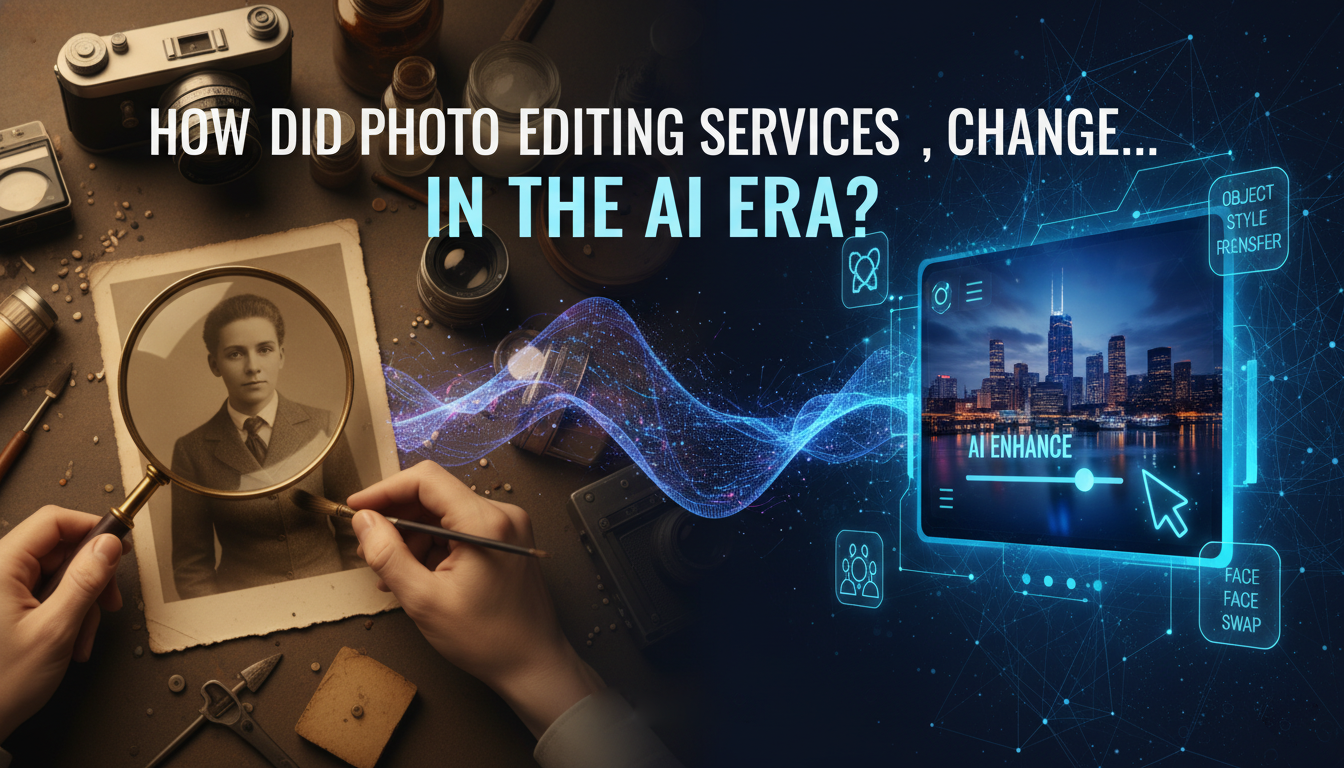
2025 was the year AI stopped being “new” and started being normal.
What AI did well
AI significantly improved:
- Background removal
- Basic color correction
- Dust and scratch cleanup
- Fast first-pass edits
- Generating variations
This reduced turnaround time and lowered entry barriers.
Where AI struggled
But ecommerce exposed AI’s limits quickly:
- Inconsistent results across batches
- Over-smoothing textures
- Invented details
- Altered colors
- Unreliable edges on complex materials
AI could make one image look good. It often failed at making 1,000 images look the same.
The winning model in 2025
The most successful photo editing services adopted a hybrid workflow:
- AI for speed and repetition
- Human editors for judgment and control
- Strict QA to protect accuracy
This mattered because ecommerce visuals are legal representations of products. Misleading images increase returns and damage trust.
In 2025, the best services did not advertise “AI-powered.”
They advertised consistency, accuracy, and reliability.
How editing supported conversions and reduced returns

One of the quiet themes of 2025 was cost control. Acquiring traffic became more expensive. Brands focused on:
- Conversion rate optimization
- Reducing returns
- Improving customer satisfaction
Photo editing played a role in all three.
Better visuals reduced hesitation
Clear images reduced:
- “Is this the right size?”
- “Is the color accurate?”
- “Will this look cheap?”
That meant fewer abandoned carts.
Accurate editing reduced returns
Returns often come from expectation gaps. Over-edited or misleading images create those gaps. Editing services that prioritized realism helped brands:
- Lower return rates
- Reduce customer complaints
- Improve reviews
Cleaner visuals improved ad performance
In paid social and search ads, clean product visuals:
- Stopped the scroll
- Loaded faster
- Scaled better across formats
This mattered in a year when ad efficiency was under pressure.
What “good” photo editing looked like in 2025?

By 2025, the market had clear expectations.
Good editing meant:
- Neutral, consistent backgrounds
- Natural shadows, not floating products
- Accurate color reproduction
- Clean but not plastic textures
- Consistent cropping and spacing
- Platform-specific exports
Bad editing was easy to spot:
- Over-smoothing
- Harsh cutout edges
- Unrealistic highlights
- Inconsistent whites
- AI artifacts
The difference was not artistic taste. It was trustworthiness.
How Buyer Behavior Changed in 2025

Buyer behavior in 2025 did not radically change overnight. It hardened.
Shoppers became faster, more skeptical, and far less forgiving. Years of exposure to polished ecommerce experiences trained buyers to detect quality instantly and to abandon anything that felt unclear or untrustworthy.
Buyers judged products visually before reading anything
In 2025, most buyers formed an opinion before reading the title, description, or reviews. The first interaction was almost always visual. If the images failed to communicate quality, accuracy, or relevance within seconds, the product was mentally rejected.
This mattered more on:
- Mobile screens
- Social media discovery
- Marketplace search results
Scrolling behavior rewarded clarity over creativity. Buyers preferred images that answered questions quickly over images that looked artistic but ambiguous.
Trust replaced curiosity as the primary driver
Earlier ecommerce years rewarded novelty and excitement. In 2025, trust became the dominant filter. Buyers asked:
- Does this look real?
- Does this match what I will receive?
- Does this brand seem reliable?
Overly stylized, over-edited, or AI-looking visuals triggered doubt. Clean, honest, well-lit product images performed better because they reduced uncertainty.
Shorter attention spans raised visual standards
Buyers no longer gave brands time to explain. They expected images to:
- Show scale clearly
- Represent color accurately
- Reveal texture honestly
- Remove visual distractions
If images created confusion, buyers moved on often without scrolling further.
In short, buyer behavior in 2025 rewarded brands that treated visuals as decision tools, not decorations.
The Rise of Hybrid Photo Editing Workflows

2025 made one thing clear: AI alone was not enough, but ignoring AI was equally unrealistic.
The most successful brands and photo editing services adopted hybrid workflows, combining automation with human judgment.
Why AI-only workflows fell short
AI tools dramatically improved speed and accessibility. Background removal, basic color correction, and quick cleanup became easy. But ecommerce exposed AI’s weaknesses:
- Inconsistent output across batches
- Altered colors and textures
- Unrealistic smoothing
- Edge errors on complex materials
- Lack of brand awareness
AI could process images fast, but it could not think like a brand.
Why human-only workflows struggled to scale
Purely manual editing delivered precision, but it struggled with:
- Large SKU volumes
- Tight turnaround times
- Frequent updates and revisions
- Cost efficiency at scale
Brands needed both speed and control.
How hybrid workflows worked in practice
Hybrid editing workflows in 2025 typically looked like this:
- AI handled repetitive first-pass tasks
- Background removal
- Basic exposure correction
- Dust and spot cleanup
- Human editors refined and verified
- Edge accuracy
- Color truth
- Texture realism
- Shadow consistency
- Brand style alignment
- QA ensured consistency across catalogs
This approach delivered:
- Faster turnaround
- Fewer errors
- Better consistency
- Lower long-term costs
- Higher trust
The takeaway from 2025 was simple: AI was a tool, not a decision-maker. Human oversight remained essential wherever product truth and brand trust were involved.
Common Mistakes Brands Made in 2025
Despite better tools and more data, many brands still made avoidable visual mistakes in 2025. Most of these mistakes were not technical, they were strategic.
Overusing AI without quality control
One of the biggest mistakes was letting AI outputs go live without review. This led to:
- Inconsistent textures
- Altered colors
- Fake-looking surfaces
- Mismatched images across listings
Buyers noticed. Trust dropped.
Inconsistent visuals across product catalogs
Many brands edited images individually instead of systemically. The result:
- Different whites across products
- Uneven shadows
- Inconsistent crop spacing
- Visual noise at the catalog level
Even if individual images looked “fine”, the collection looked unprofessional.
Editing for beauty instead of accuracy
Over-polishing products was a major error. Excessive smoothing, unrealistic lighting, or enhanced colors created expectation gaps. When products arrived, they did not match the images.
That led to:
- Higher return rates
- Negative reviews
- Long-term brand damage
Ignoring mobile and platform-specific crops
Brands that edited images only for desktop views struggled. Important details were cut off in:
- Mobile previews
- Social feeds
- Marketplace thumbnails
Visual hierarchy and safe cropping zones were often ignored.
Treating editing as a cost, not an investment
Some brands minimized editing budgets to save money, only to lose it later through:
- Lower conversions
- Higher ad costs
- Increased returns
- Weaker brand perception
In 2025, cutting visual quality rarely saved money, it shifted the cost downstream.
Experts’ Predictions for 2026

- E-commerce Sales Will Continue Growing, But With Smarter Metrics
Experts expect global ecommerce to keep expanding in 2026, though not at pandemic-era speed. Growth will come from deeper penetration in emerging markets, stronger mobile ecommerce, and increased social ecommerce conversions.
Major trends predicted:
- More transactions through social platforms and short-form ecommerce
- Greater integration of AI in customer experience (recommendations, search, personalization)
- Higher expectations for transparency and sustainability
In 2026, revenue growth will likely be measured not just in total sales, but in efficiency, profitability, and repeat buyer value.
- Product Photography Will Shift Toward Story-Driven and Contextual Visuals
Basic product photos will remain essential, but experts predict a shift toward visuals that do more than just show the product.
Visual priorities in 2026:
- Contextual storytelling photography that places products in relatable real-world settings
- Dynamic lifestyle content optimized for video and immersive formats
- Emotion-based imagery for deeper brand connection
- AI–generated layout variations for multichannel campaigns
Product photography will be less about static catalog images and more about visual narratives that bridge discovery and decision.
-
Photo Editing Services Will Evolve With AI Transparency and Brand Consistency at the Core
Photo editing in 2026 will not be about replacing humans with AI-experts anticipate deeper AI–human collaboration where:
- AI accelerates repetitive tasks (background removal, color matching)
- Human editors ensure visual truth and brand alignment
- Quality control systems leverage machine learning for batch consistency
The most in-demand photo editing services will:
- Provide verified color accuracy across devices
- Deliver platform-specific exports (marketplaces, social, mobile)
- Support brand style governance at scale
- Use data analytics to optimize visual performance (e.g., which image variants drive conversion)
Transparency will matter: brands and editing partners that can explain exactly how edits affect perception and performance will win trust.
- Overall Visual eCommerce Will Be a Strategic Growth Lever, Not a Creative Expense
Across all three areas- ecommerce sales, photography, and editing- the prediction for 2026 is clear:
Visual quality will be treated as a business driver, not a creative afterthought.
Data will increasingly guide decisions:
- Visual performance tied to conversion rates
- A/B testing of image variants
- Visual analytics embedded in ecommerce platforms
In 2026, visuals will shape not only what buyers see, but how they feel, what they trust, and whether they return.
The big takeaway from 2025
2025 showed that ecommerce had entered a professional phase.
Sales were massive, but competition was ruthless. Buyers were informed. Platforms were strict. AI was everywhere.
In that environment:
- Product photography remained essential
- Photo editing became non-negotiable
- Consistency mattered more than creativity
- Accuracy mattered more than perfection
- Hybrid human-AI workflows outperformed automation alone
The brands that won were not necessarily the cheapest or the loudest. They were the ones whose visuals made buying feel safe, clear, and predictable.
And that, more than any trend or tool, defined ecommerce sales, product photography, and photo editing in 2025.