Ghost Mannequin vs Flat Lay: Which Converts Better in Fashion eCommerce?
If you sell fashion online, your product images are doing one job:
Convincing a stranger to spend money without touching the product. No fitting room. No fabric feel or mirror check.
Just images.
The choice between ghost mannequin and flat lay photography impacts more than style. It affects conversion and return rates, and a brand’s position.
So which one converts better? The short answer: it depends.
The real answer: it depends on structure, price point, audience psychology, and execution quality.
Let’s break it down properly.
Why This Question Matters More Than You Think
Fashion eCommerce has a trust problem. Customers are constantly wondering:
- Will this fit the way I expect?
- Is this brand legit?
- Is this worth the price?
- Will it look cheap in real life?
Your photography style either reduces doubt or increases it. And conversion is simply the removal of doubt.
So when we compare ghost mannequin vs flat lay, we’re really asking: Which one reduces doubt faster?
What Is Ghost Mannequin Photography?
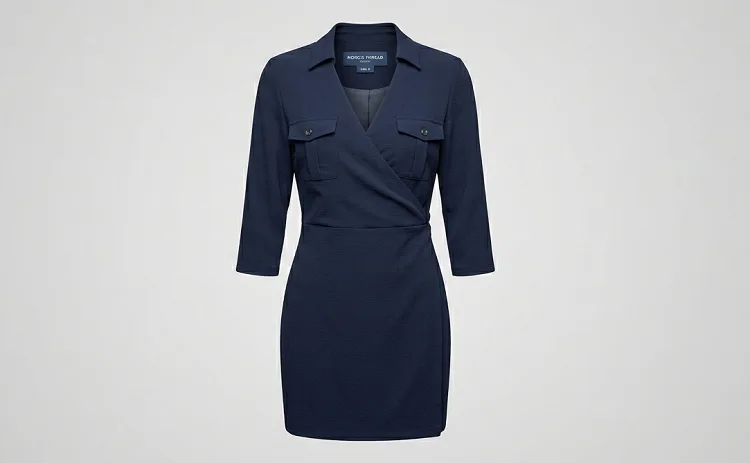
Ghost mannequin photography shows a garment in 3D without a visible model. Post-production removes the mannequin, creating a hollow look.
How It Works
- The garment is placed on a mannequin.
- Front and additional inner shots (like neckline or interior collar) are taken.
- In editing, the mannequin is removed.
- The interior area is stitched in.
- The final image shows the full structure without distraction.
When done well, it appears clean, balanced, and professional. However, when done poorly, it can look artificial and erode trust.
What Is Flat Lay Photography?
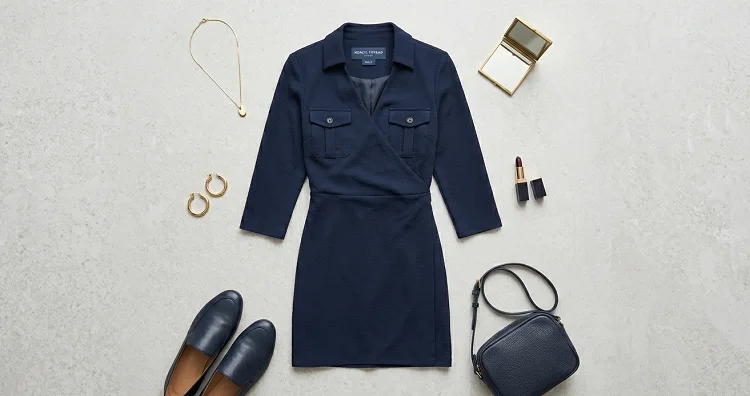
Flat lay photography shows clothing laid flat on a surface. Photographers take it from above.
It’s simple, fast, and widely used. There are two major types:
- Minimal flat lay (pure white background, catalog style)
- Styled flat lay (with accessories, props, textures)
Flat lay is common in:
- Streetwear brands
- Budget apparel lines
- Social-media-driven brands
- High-volume SKU businesses
It’s practical. But it’s also 2D. And that 2D limitation changes how buyers interpret your product.
The Core Difference: 3D Perception vs 2D Presentation
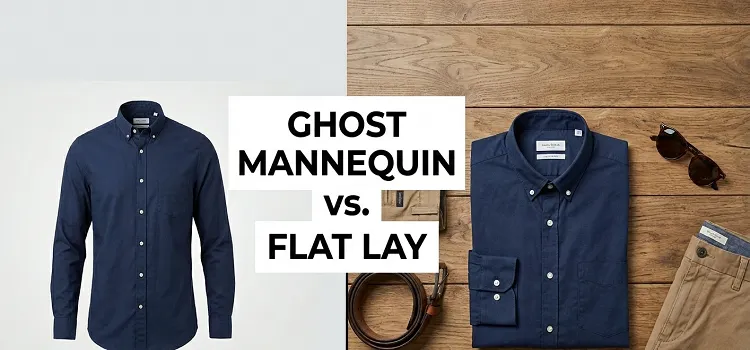
This is the heart of the conversion debate. Ghost mannequin shows:
- Shoulder structure
- Sleeve fall
- Waist shaping
- Drape and form
Flat lay shows:
- Fabric surface
- Overall shape outline
- Print and texture
If your product depends on structure to sell, 3D perception matters. If your product is simple and loose, 2D may be enough.
The Psychology of Conversion
Let’s step back and think like a buyer. When someone views a product page, they are unconsciously asking:
- Can I imagine myself wearing this?
- Does this look high quality?
- Does this brand look trustworthy?
Photography style influences all three.
Fit Visualization
Fit is the #1 cause of apparel returns. Ghost mannequin helps customers visualize:
- How the garment sits on the shoulders
- Whether it tapers at the waist
- Whether sleeves look structured or relaxed
Flat lay does not show body contour. If your product relies on tailoring, ghost mannequin reduces guesswork.
Less guesswork = more confidence.
More confidence = higher conversion.
Perceived Brand Value
Two brands sell identical blazers. Brand A uses flat lay. Brand B uses structured ghost mannequin images.
Which one feels more premium? Even if the product is the same, a structured presentation increases perceived value.
And perceived value influences pricing power. If you want to raise prices, your visuals must justify it.
Thumbnail Impact (Mobile Reality)
Most traffic today is mobile. In small thumbnails:
- Structured ghost mannequin images often stand out better for jackets and dresses.
- Flat lay can lose definition for tailored items.
In competitive marketplaces, clarity in small previews affects click-through rate. That’s not theory. That’s browsing behavior.
Where Ghost Mannequin Wins
Ghost mannequin typically performs better for:
- Blazers
- Coats
- Tailored dresses
- Button-down shirts
- Premium outerwear
- Structured uniforms
Why? Because structure is part of the selling point. If you flatten a structured blazer, you remove its strongest visual asset.
Ghost mannequin restores shape.
Where Flat Lay Wins
Flat lay works well for:
- Graphic tees
- Loungewear
- Kids clothing
- Sweatshirts
- Casual streetwear
If the garment has minimal structure and the selling point is design or print, flat lay may be enough.
In these cases, ghost mannequin doesn’t add significant conversion value.
The Price Point Factor
Here’s something most brands ignore. Price determines visual expectation.
A $20 t-shirt can survive flat lay.
A $180 structured dress cannot.
The higher your price:
- The more visual authority you need
- The more structure matters
- The more professionalism influences trust
If you’re moving into a premium bracket but still using budget-style imagery, conversion suffers quietly.
Return Rate Consideration
Returns reduce profit. Many apparel returns happen because: “It didn’t look how I expected.”
Ghost mannequin reduces this by showing:
- Collar shape
- Shoulder width
- Interior detail
- Proportions
Flat lay leaves interpretation to the buyer. Interpretation increases risk. Risk reduces conversion.
The Execution Factor (This Is Where Most Brands Fail)
Here’s the truth. Style matters less than execution quality. A badly edited ghost mannequin looks worse than a clean flat lay.
Common ghost mannequin mistakes:
- Jagged neckline stitching
- Uneven hollow effect
- Distorted symmetry
- Unnatural shadows
Common flat lay mistakes:
- Wrinkles
- Inconsistent folding
- Uneven lighting
- Crooked alignment
- Background discoloration
If execution is sloppy, conversion drops regardless of style. This is where professional retouching becomes critical, not as a marketing add-on, but as a consistency system.
Brands that scale volume often underestimate this.
The Hybrid Strategy (Often the Best Approach)
The highest-performing fashion stores rarely rely on one format only. They use:
- Ghost mannequin as primary image
- Flat lay as a secondary angle
- Close-ups for fabric detail
- Lifestyle images for context
Why this works: You answer multiple buyer questions simultaneously.
Structure + clarity + storytelling.
When doubt decreases from all angles, add-to-cart rate increases.
Case Scenario 1: Structured Apparel Brand
A mid-range brand selling tailored dresses was using flat lay for all SKUs. Problem:
- Customers couldn’t clearly visualize the waist shape
- Return rate was high
- Conversion stalled
They switched to ghost mannequin for primary images. Results over several months:
- Improved fit confidence
- Stronger product page engagement
- Lower confusion-related returns
The style didn’t magically increase sales. Fit clarity did.
Case Scenario 2: Streetwear Brand
A streetwear brand selling graphic tees used a ghost mannequin initially. But their audience was social-first and casual.
They switched to a creative flat lay with strong symmetry and clean retouching. Result:
- Better brand consistency
- Stronger social media visuals
- Conversion stayed stable
Lesson: Audience psychology matters more than trends.
Marketplace Consideration (Amazon, Large Retail Platforms)
Marketplaces reward clarity and consistency. Ghost mannequin often performs better for structured apparel because:
- It stands out in small thumbnails
- It communicates shape quickly
- It looks catalog-ready
Flat lay works fine for simple items, but can struggle in competitive, structured categories. If your main channel is marketplace-driven, structure visibility becomes more important.
Cost vs ROI
Flat lay:
- Lower setup cost
- Faster production
- Minimal editing complexity
Ghost mannequin:
- Requires mannequin setup
- Needs multi-shot stitching
- Demands advanced retouching
But here’s the ROI reality: If ghost mannequin increases conversion by even 0.5%, the additional editing cost is often insignificant compared to revenue gain.
Brands should measure:
- Conversion rate
- Return rate
- Average order value
- Cost per image
How to Decide for Your Brand
Ask yourself:
- Is structure a selling feature?
- What is my average selling price?
- What is my return rate?
- Does my audience expect premium presentation?
- What does my competitor’s top performer use?
If structure and price are high → lean ghost mannequin. If casual and budget-focused → flat lay can work. And lastly, if unsure → test both.
A/B testing image style is underused in fashion eCommerce. It shouldn’t be.
The Role of Professional Retouching
Whether you choose ghost mannequin or flat lay, consistency is non-negotiable. Large catalogs amplify small mistakes.
Inconsistent lighting, background tone shifts, and changes in shadow direction can all weaken brand perception through subtle errors.
Professional post-production ensures:
- Color accuracy
- Symmetry
- Clean edges
- Background consistency
- Marketplace compliance
Many growing brands outsource this stage, not because they can’t edit, but because scaling clean execution internally becomes difficult.
That’s typically where specialized post-production partners like Color Experts (CEI) support brands quietly in the background, not changing style, but improving consistency and precision.
The style decision remains strategic. The execution quality becomes operational.
Common Mistakes That Kill Conversion
Regardless of style, avoid:
- Over-smoothing fabric texture
- Removing natural shadow depth
- Overexposed white backgrounds
- Cropping too tight
- Inconsistent image ratios
- Poor mobile framing
Small details compound at scale. Conversion optimization in fashion is often 10% strategy and 90% execution discipline.
So… Which Converts Better?
If forced into a single answer: For structured garments and mid-to-high price points, ghost mannequin generally converts better.
For simple, casual, print-focused garments, flat lay performs sufficiently when executed well.
But the smartest brands:
- Test
- Combine
- Optimize
- Measure
They don’t pick based on trend. They pick based on performance data.
Final Takeaway
This isn’t a design debate. It’s a confidence equation. Ghost mannequin reduces fit uncertainty. Flat lay simplifies presentation for casual items.
Conversion happens when buyer hesitation disappears. Your photography style should support that, not fight it. And if you want one practical rule to remember:
If the garment’s shape sells the product, show the shape. If the garment’s surface sells the product, show the surface.
Choose strategically. Execute flawlessly. Measure consistently. That’s how fashion eCommerce scales.