Current Trends in eCommerce Product Photos- 2026
In 2026, product photography is not just “nice to have.” It is the front door of your business and a core part of current trends in eCommerce. Most shoppers never read your specs first. They scan your visuals, decide if you look trustworthy, and only then give your copy a chance.
That shift got stronger because shopping behavior moved even further toward mobile. StatCounter’s worldwide platform data shows mobile at 54% vs desktop 46% (December 2025), and that split shapes how product photos must look and load today.
So what is “current trend” in 2026?
Not one single style. Not one filter. The real trend is this: product images have become a performance system. Brands build photo sets the way they build funnels, with measurable goals like conversion, return-rate reduction, and ad efficiency. Meanwhile, AI tools speed up post production, and human product photo editing protects accuracy and brand trust.
Let’s break down what is working right now, with the data and the practical choices behind it.
1) Mobile-first images are no longer optional

A lot of ecommerce photography advice still sounds like it was written for desktop shoppers on a big monitor. That world is gone.
Mobile shopping forces a harsh rule: if your product cannot “read” at thumbnail size, you lose. Your hero image has to communicate the product category, the value signal, and the quality cue in a split second.
That is why you see 2026 catalogs trending toward:
- Tighter crops
- Simpler backgrounds
- Stronger silhouette visibility
- Cleaner lighting with fewer confusing reflections
Even social platforms are reinforcing vertical-first visual standards. Instagram has been moving away from the classic square grid toward a taller, more vertical layout, reflecting how people actually post and consume content today.
What to do in 2026
- Shoot for multiple crops: wide (banner), square-ish (marketplace), portrait (social + mobile PDP).
- Build a “thumbnail test” into QA: zoom out until the product is tiny. If it becomes ambiguous, reshoot or recrop.
- Keep the hero image dumb-simple. Save storytelling for secondary images.
Is mobile first still a thing?
Yes. Mobile-first isn’t a trend anymore. It’s the default.
Most shoppers now discover, compare, and buy on their phones. That reality shapes everything, from image crops to page speed. If your product photos do not communicate clearly on a small screen, you’re invisible. In 2026, brands that design for mobile first don’t follow best practice. They follow user behavior.
2) “White background” is still king, but brands are upgrading the execution

White-background product photos never died. Marketplaces and comparison-shopping behavior keep them alive.
Amazon’s image guidelines still emphasize pure white background (RGB 255,255,255) for a consistent shopping experience. That requirement pushes sellers toward clean cutouts and standardized lighting.
Here is what changed in 2026: the white background look got more sophisticated.
Instead of flat, floating objects, high-performing catalogs now aim for:
- Cleaner, softer shadows
- More accurate whites (not blue, not gray)
- More texture visibility
- Better edge realism (no jagged halos)
So yes, white backgrounds remain dominant. Yet the craft moved from “remove background” to “make it feel real.”
What to do in 2026
- Treat white as a controlled color, not an empty space.
- Standardize: same shadow density, same floor feel, same highlight behavior across the whole catalog.
- Audit edges. A bad cutout destroys trust faster than slightly imperfect lighting.
Is white a good background color for product images?
Yes. White is still the gold standard for product photos, especially on ecommerce platforms. It keeps the focus on the product, not the background. Marketplaces like Amazon even require it. A clean white backdrop also makes your images look professional, consistent, and easy to compare. Just make sure it’s a true white, not gray or blue. Clean doesn’t mean boring. It means trustworthy.
What background color is best for product images?
For most ecommerce brands, white is still the gold standard. It keeps attention on the product, loads cleanly on every platform, and meets marketplace guidelines like Amazon’s.
That said, context matters. Lifestyle brands often use soft neutrals or subtle textures to add mood without stealing focus. The real rule is simple: the background should never compete with what you’re selling. If it distracts, it fails.
3) Multi-image sets are rising because returns hurt (and retailers are tightening)
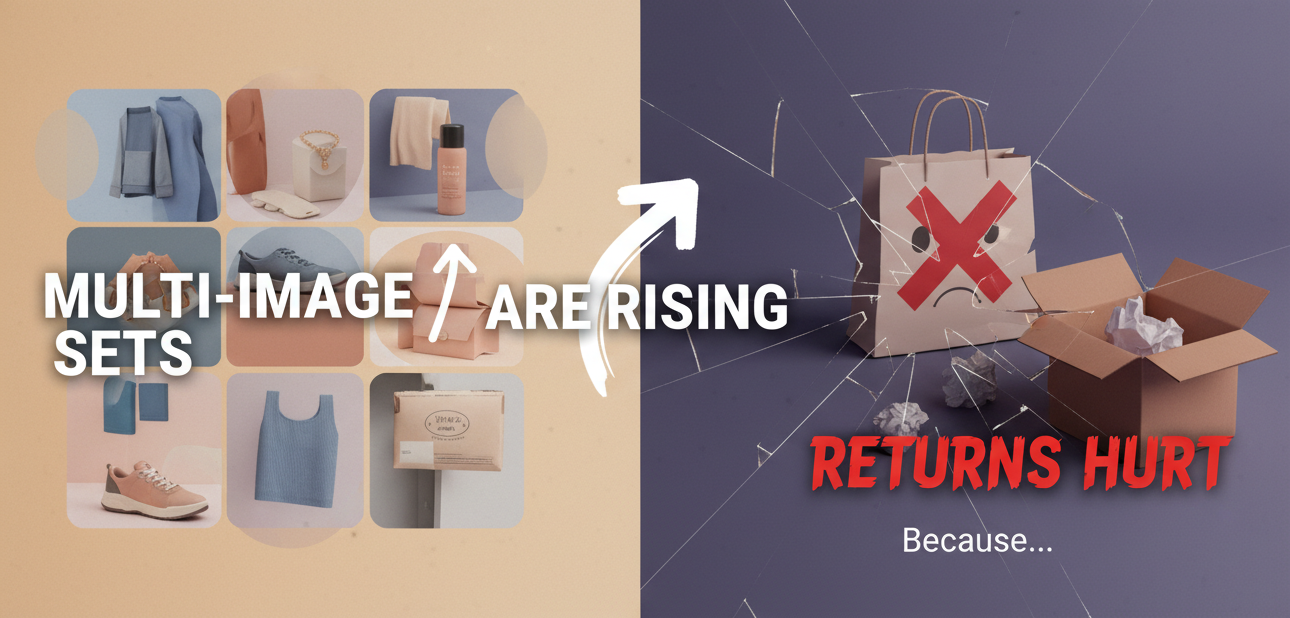
Returns are not a small operational detail anymore. They are a headline-level business problem.
NRF and Happy Returns reported that retailers estimated 16.9% of annual sales would be returned in 2024, totaling $890B. Then NRF projected 15.8% returns in 2025 (about $849.9B).
Those numbers push a very specific photo trend: more angles, more clarity, less surprise.
You can feel this in 2026 product pages:
- More close-ups of materials
- More “fit and scale” images
- More packaging shots (what arrives at the door)
- More detail layers for hardware, stitching, texture
Returns are also forcing retailers to get stricter on policies and fees, which raises the stakes for getting the purchase right the first time.
What to do in 2026
- Add “return-prevention” shots: measurements, size references, and real texture close-ups.
- Use consistent color management. Color mismatch drives buyer disappointment.
- Build a “what buyers misunderstand” gallery section for your top SKUs.
4) Ultra-high-resolution zoom is back, but it must stay honest

Zoom is not a gimmick. It is a trust mechanic.
Shoppers want to inspect a product the way they would in a store: fabric weave, grain, seams, printing quality, edges, reflectivity. That demand pushes brands toward high-res photography and detail-first editing.
The problem: some teams “enhance” details too aggressively. Over-sharpening and AI texture hallucination can create a product that looks better than reality, which comes back as refunds and bad reviews.
So the 2026 trend is high resolution with restraint.
What to do in 2026
- Keep texture real. If the product is matte, do not polish it into gloss.
- Avoid aggressive AI “upscalers” on product texture unless you QA at 200% and compare to original.
- Use close-ups for clarity, not hype.
5) Authentic lifestyle and UGC keep gaining ground

A polished studio hero still matters. Yet buyers increasingly want proof that the product works in real life.
That is why 2026 product galleries blend:
- Studio “truth” images
- Lifestyle context (usage, environment, scale)
- UGC (real customers, real lighting, real outcomes)
The broader cultural trend is moving away from overly perfect visuals and toward authenticity, even on image-heavy platforms. Instagram leadership has openly talked about the shift away from “polished” professional photos as the center of engagement.
UGC also performs because it feels like social proof, not marketing.
What to do in 2026
- Create a “Customer photos” gallery section with consistent moderation.
- Curate UGC so it supports your brand without looking staged.
- Make sure UGC does not contradict your studio images. Consistency still wins.
6) Short-form video and “motion-first” product visuals are becoming standard

Look at how people shop on TikTok, Instagram, and live commerce streams. Movement sells.
In 2026, brands increasingly treat product photography as part of a visual bundle:
- Hero photo
- Detail photos
- Lifestyle photos
- Short clips (5–12 seconds)
- Loopable micro-motion (spin, pour, flex, snap, shimmer)
Even when a page is “photo-first,” the photo set often gets designed to match video frames. That creates brand consistency across PDP, ads, and social.
What to do in 2026
- Shoot with motion in mind. Capture angles that translate into video.
- Design a repeatable “motion shot list” for each product category.
- Keep lighting consistent across photo and video. Mixed lighting kills trust.
7) 3D, AR, and virtual try-on are finally practical for more brands

For years, 3D product modeling sounded like a big-brand toy. In 2026, it is becoming a normal conversion tool.
Shopify has reported strong results tied to immersive commerce. One Shopify article notes merchants using 3D commerce saw an average 94% increase in conversions. Shopify’s own product updates have echoed a similar figure for conversion lift when 3D content is added.
Think with Google also cites Shopify’s finding that products advertised with VR/AR content saw 94% higher conversion than those without, and highlights broad consumer openness to AR shopping experiences.
Fashion and beauty have been pushing harder into AR experiences to reduce uncertainty and returns. Virtual try-on and avatar-based fitting tools are being used specifically to address fit issues that drive returns.
The key trend here is not “AR everywhere.” It is AR where it reduces doubt:
- Furniture scale in a room
- Eyewear try-on
- Apparel sizing and drape
- Home decor placement
What to do in 2026
- Start with one high-return category and test impact on conversion and returns.
- Do not abandon photos. AR works best when photos already build trust.
- Use 3D/AR as an “objection-killer,” not as decoration.
8) AI is powering image production, but hybrid QA is the winning workflow

AI changed ecommerce photography faster than most brands expected. Today, AI can:
- Remove backgrounds
- Generate variants for ads
- Assist with lighting normalization
- Speed up repetitive cleanup
Shopify’s AI tooling push reflects how central AI has become to modern commerce operations, including visual content creation.
Still, the 2026 winners are not “AI-only.” The winners run a hybrid workflow:
- AI handles volume and repetitive tasks
- Humans handle accuracy, texture realism, and brand consistency
- QA checks sets, not single images
Why does hybrid win? Because buyers punish visual dishonesty. Also, marketplaces punish inconsistency.
What to do in 2026
- Use AI as a first pass, not the final pass.
- Lock a style guide: shadow rules, white point, crop ratios, highlight control.
- QA in grids. One image can look fine alone while the set looks chaotic.
9) “Visual systems” beat “pretty photos” in scalable catalogs

This may be the most important 2026 trend, and it sounds boring until you see the impact.
High-performing brands treat product photos as a system:
- Standardized lighting
- Consistent camera angle families
- Repeatable styling rules
- Clear crop ratios per channel
- Consistent color strategy
That system makes the catalog feel reliable. It also speeds up production because decisions happen once, then repeat.
Baymard’s research-driven product page UX work consistently emphasizes how users rely on product presentation and imagery to evaluate suitability, and their benchmarking shows many ecommerce sites still perform only “mediocre” on product page UX.
In other words, most brands still leave money on the table.
What to do in 2026
- Build a product image “playbook” for your top 20% SKUs.
- Create a template gallery: hero, angle set, close-ups, scale, lifestyle, and packaging.
- Enforce one lighting recipe. Variations belong in campaigns, not in the core catalog.
10) More localization and compliance variants for global ecommerce

As ecommerce scales globally, photos must pass different cultural expectations and platform standards.
A single “master” photo often is not enough. Brands generate multiple variants:
- Marketplace-compliant version
- DTC storytelling version
- Region-specific modesty or content-safe version
- Platform-safe version for ads
This trend grows because regulations, ad policies, and audience norms vary by region and placement type. Even within a “single country” rules can differ by medium.
What to do in 2026
- Build a variant naming system so teams do not ship the wrong version.
- Maintain a change log for compliance edits.
- Treat localization as a production step, not a last-minute panic.
11) Accessibility and metadata are creeping into “product photography” conversations

This trend won’t show up in a moodboard, but it shows up in performance.
Image SEO and accessibility matter because:
- Search engines rely on context signals (like alt text)
- Shoppers using assistive technology need clear descriptions
- Better metadata supports product discovery
More brands now build image naming conventions and alt-text workflows into their catalog operations. It is not glamorous. It is measurable.
What to do in 2026
- Use descriptive filenames for core assets.
- Write alt text that describes what is actually visible.
- Keep it consistent across variants.
12) The “return-reduction photo set” is becoming a competitive advantage

Returns carry major cost, and media coverage keeps highlighting how complex and wasteful the returns pipeline can be. Investopedia notes online return rates rising over time and explains that many returns do not simply go back to shelves.
This reality changes photography priorities.
The modern product gallery does two jobs:
- make the product look attractive
- make the product look accurate
If you only do job #1, you get returns.
What to do in 2026
- Include a “truth shot” even if it looks less cinematic.
- Add dimension cues: hands, body, common objects, or measurement graphics.
- Be honest about imperfections. Buyers do not fear flaws as much as they hate surprises.
A practical 2026 checklist you can steal

Hero
- Clear silhouette at thumbnail size
- Accurate color and texture
- Shadow feels intentional, not fake
Angle set
- Front, back, side, 3/4
- Close-ups on key materials
- Details on fasteners, stitching, controls
Context
- At least 1 scale shot
- At least 1 lifestyle/usage shot
- Optional UGC section for trust
Performance
- Fast-loading, optimized sizes
- Alt text and clean filenames
- Variants for mobile, social, marketplace
Workflow
- AI assists repetitive tasks
- Human QA protects realism
- Style guide keeps the catalog consistent
The big takeaway for 2026
The trend is not “more editing” or “less editing.”
It is better visual truth at scale.
Mobile-first composition pushes simplicity. Returns push accuracy. Social pushes authenticity. 3D and AR push interactivity. AI pushes speed, while humans protect trust. Put those forces together, and you get the 2026 product photo playbook.
What are the major trends in e-commerce?
E-commerce in 2026 runs on three forces: speed, personalization, and visual trust. Mobile-first shopping dominates, while social commerce keeps pulling buyers straight from feeds to checkout. AI now powers product recommendations and customer support, but brands still win on authenticity. Shoppers expect better images, faster delivery, and flexible returns. In short, convenience sets the baseline. Experience sets the winners.
What are the top 10 consumer trends right now?
Here are the top 10 consumer trends right now, explained in a clear, no-fluff style:
- Mobile-first buying – People shop on phones first, laptops second. Brands design for thumbs, not mice.
- Trust over hype – Shoppers want real reviews, honest images, and transparent policies. Flashy marketing feels fake.
- Value-driven spending – Price matters again. Consumers compare harder and abandon carts faster.
- Fast delivery expectations – Two days feels normal. One day feels premium.
- Social commerce growth – TikTok and Instagram aren’t just for scrolling anymore. They’re shopping malls now.
- Personalization – Buyers expect recommendations that actually make sense.
- Sustainability awareness – People care where products come from, even if budgets are tight.
- AI-powered shopping – From chat support to product discovery, AI is everywhere.
- Short attention spans – If it’s not clear in three seconds, it’s ignored.
- Experience over ownership – Subscriptions, rentals, and try-before-you-buy keep growing.
Consumers today are faster, smarter, and harder to impress. Brands that respect their time and trust will win.
What are the 7 types of e-commerce?
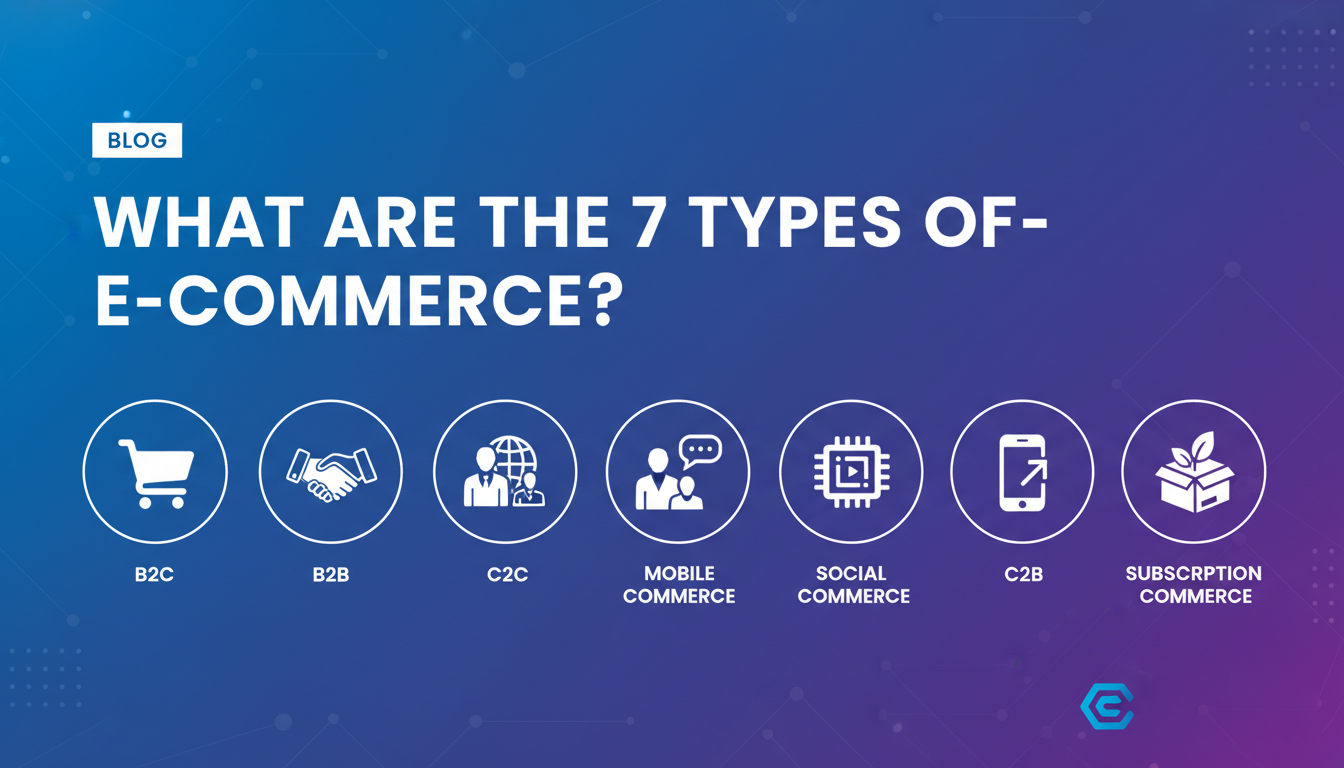
The seven main types of e-commerce describe who sells to whom. Here they are, in plain English:
- B2C (Business to Consumer)
Brands sell directly to everyday shoppers. Think Amazon, Nike, Apple. Consumers can directly order to the brands, buy products and consume. - B2B (Business to Business)
Companies sell products or services to other companies. Software tools and wholesale platforms live here. - C2C (Consumer to Consumer)
People sell to other people. eBay and Facebook Marketplace made this mainstream. - C2B (Consumer to Business)
Individuals offer services or products to brands. Freelancers and influencers fit this model. - D2C (Direct to Consumer)
Manufacturers skip retailers and sell straight to buyers. Warby Parker is a classic example. - B2G (Business to Government)
Companies supply goods or services to government agencies. Think contracts and tenders. - G2C (Government to Consumer)
Public services sold or delivered online, like license renewals or tax payments.
Different models, same goal: moving value through a screen instead of a storefront.
What are the 4 C’s of e-commerce?
The 4 C’s of e-commerce highlights on that really matters to buyers, not brands.
- Customer comes first. Everything starts with understanding their needs, habits, and expectations.
- Cost replaces price. Shoppers care about total value, including shipping, returns, and long-term benefits.
- Convenience wins loyalty. Fast checkout, mobile access, and smooth delivery keep people coming back.
- Communication builds trust. Clear messaging, reviews, and support turn browsers into customers.
In short, it’s about serving people, not just selling products.
What are the pillars of e-commerce?
E-commerce stands on four core pillars.
- Technologies are the ones driving the engine. Your platform, payment systems, and site speed determine how seamless the experience is.
- Customer experience is the final step. A simple design, attractive visuals, and easy navigation all ensure shoppers continue on their journey.
- Operations work on the promises. Products, shipping, and returns establish confidence after the purchase.
- Marketing is the one bringing the customers. SEO, ads, social media, and email are the channels which bring buyers to you.
When these four are in harmony, online stores do not only sell but also scale.
Is ecommerce profitable?
Yes, ecommerce is profitable. You have to take it seriously like any other business. But if you consider it as a side hustle, it may not work. The ecommerce winners focus on profit margins, not just on the quantity of sales. They minimize costs, try to build up trust of the customers with appealing product visuals, and invest in customers’ satisfactory experience. Growth alone does not ensure high profit. Smart operations that can do.